Fool me once, shame on you.
Fool me twice, shame on me.
When the TeleMessage breach occurred in mid-2025, we all pointed our fingers. Companies told their employees to stop using Signal and WhatsApp, (forcing habits to change) because they lacked reliable mechanisms for immutable capture, retention, and supervisory review.
Why iMessage Escaped Scrutiny
But one platform quietly avoided the same scrutiny. iMessage. After all, there hasn’t been a breach yet.
Apple’s messaging stack was never designed to be a WORM-compliant archive. It is designed for everyday use. Messages can be edited & deleted. Storage limits apply. Backup settings are user-controlled.
iMessage Is Working as Designed
None of that is a direct flaw. It’s functioning as intended.
Because Apple Messages does not provide native WORM storage, compliance teams turn to external tools and third-party vendors to archive business-related iMessages. When evaluating third-party compliance vendors, compliance officers should avoid solutions that state they rely on iCloud data backups.
Where Compliance Assumptions Start to Break
Some widely used compliance platforms rely first on Apple’s own message storage before syncing messages into their WORM-compliant archive. During that window, messages live in a system that allows normal user actions. If a message is edited or deleted on the device before synchronization occurs, the version that exists in iCloud at the moment of retrieval is what gets captured and archived by those compliance solutions.
Apple’s own documentation makes this clear. For example, Apple states that when you turn on Messages in iCloud, your message history is kept up to date across all your devices and that deleting a message on one device removes it from all.
Obviously, messages must be present and accessible in iCloud when the compliance solution goes to collect them. What this means, though, is that the archive reflects what exists at the moment it synchronizes, not necessarily what was originally sent. This gap can lead to significant risks, with organizations potentially incurring high remediation costs and facing compliance failures.
If your archiving workflow relies on Apple Messages before records are written into immutable storage, several things have to go right:
-Messages must still exist on the device.
-They must not be edited or deleted before capture.
-iCloud or device backups must be enabled and functioning. (a user can change this)
-Storage limits must not be reached. (that pesky 10 GB)
-The device must be connected to power, and on a lock screen.
-Sync must occur before any of those conditions change.
When all these requirements are met, great! The solution works. When they are not, messages can be edited, deleted, or lost before they ever reach the archive, leaving gaps, not records.
This should feel familiar. With TeleMessage, everything appeared to be working until the breach exposed how messages were actually being handled. So, yes. Fool me twice… you know the rest.
The difference is architectural.
At Comma, we want you to ensure that your “compliance” software actually is compliant - that it works regardless of how external systems operate.
In iCloud backup-based approaches, the sequence is different. A message is first sent in iMessage. If iCloud Backup is enabled, storage limits have not been reached, the device is connected to power, and the screen is locked, Apple states that iMessages are backed up to iCloud as part of a daily backup. That backup may occur seconds, minutes, or hours after the message is sent.
Only after the backup runs does the compliance solution capture the message, pulling it from iCloud backup data. Vendors generally do not publish how frequently this capture process runs. In this model, the risk window is defined by backup timing, not by message delivery.
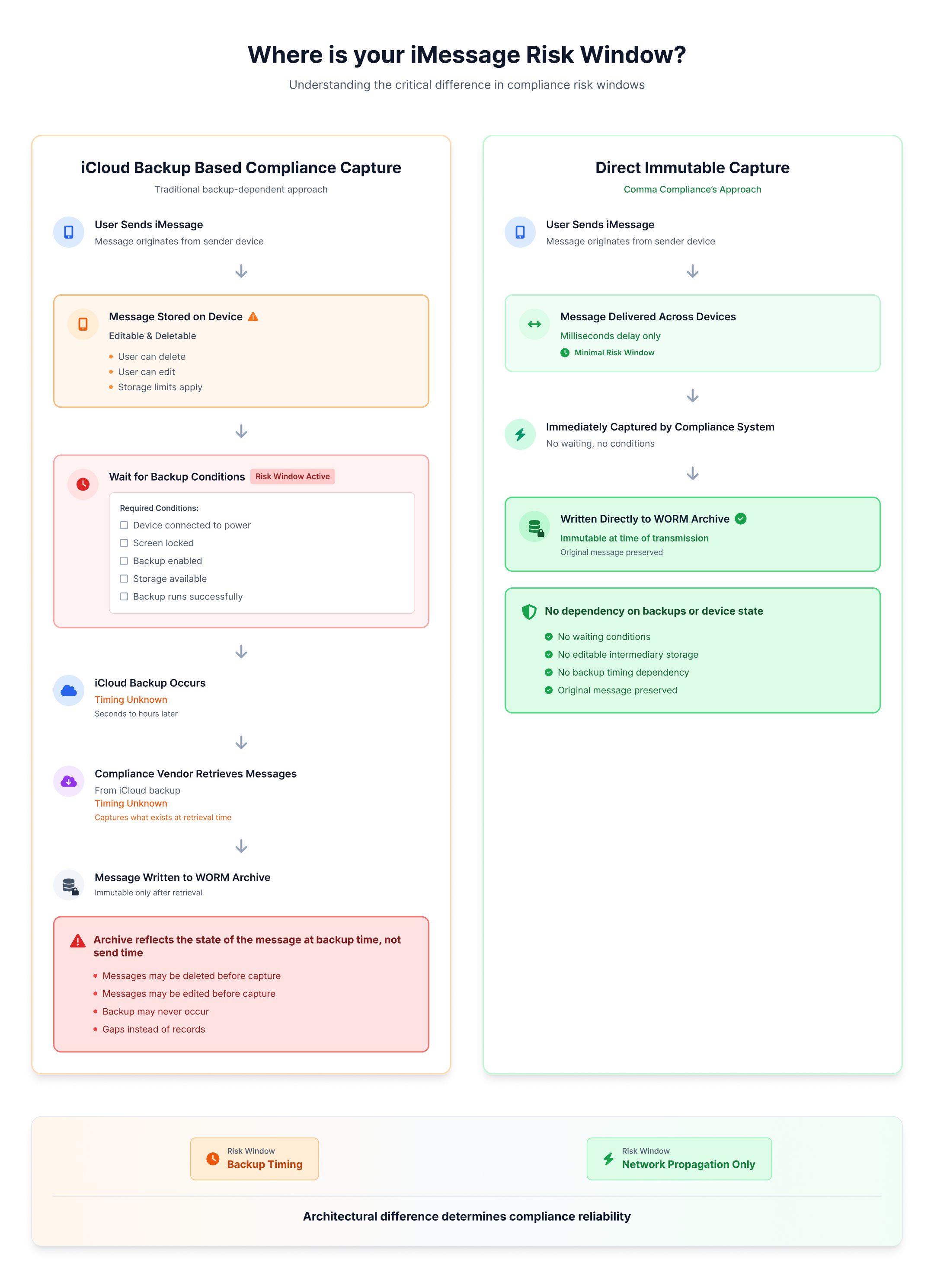
The issue is not iCloud. The issue is using a mutable, consumer messaging store as an intermediary in a compliance-capture workflow.
With Comma Compliance, the capture window is limited to message propagation between iMessage endpoints. Similar to receiving an iMessage on both a phone and a computer, there may be a brief delay measured in milliseconds. That delay is the entire risk window.
The TeleMessage breach made one thing clear: assumptions and confidence about a third-party vendor don’t actually mean that your messages are stored in a compliant manner. Apple storage does not need to be WORM-compliant, but compliance vendors do. Period.