
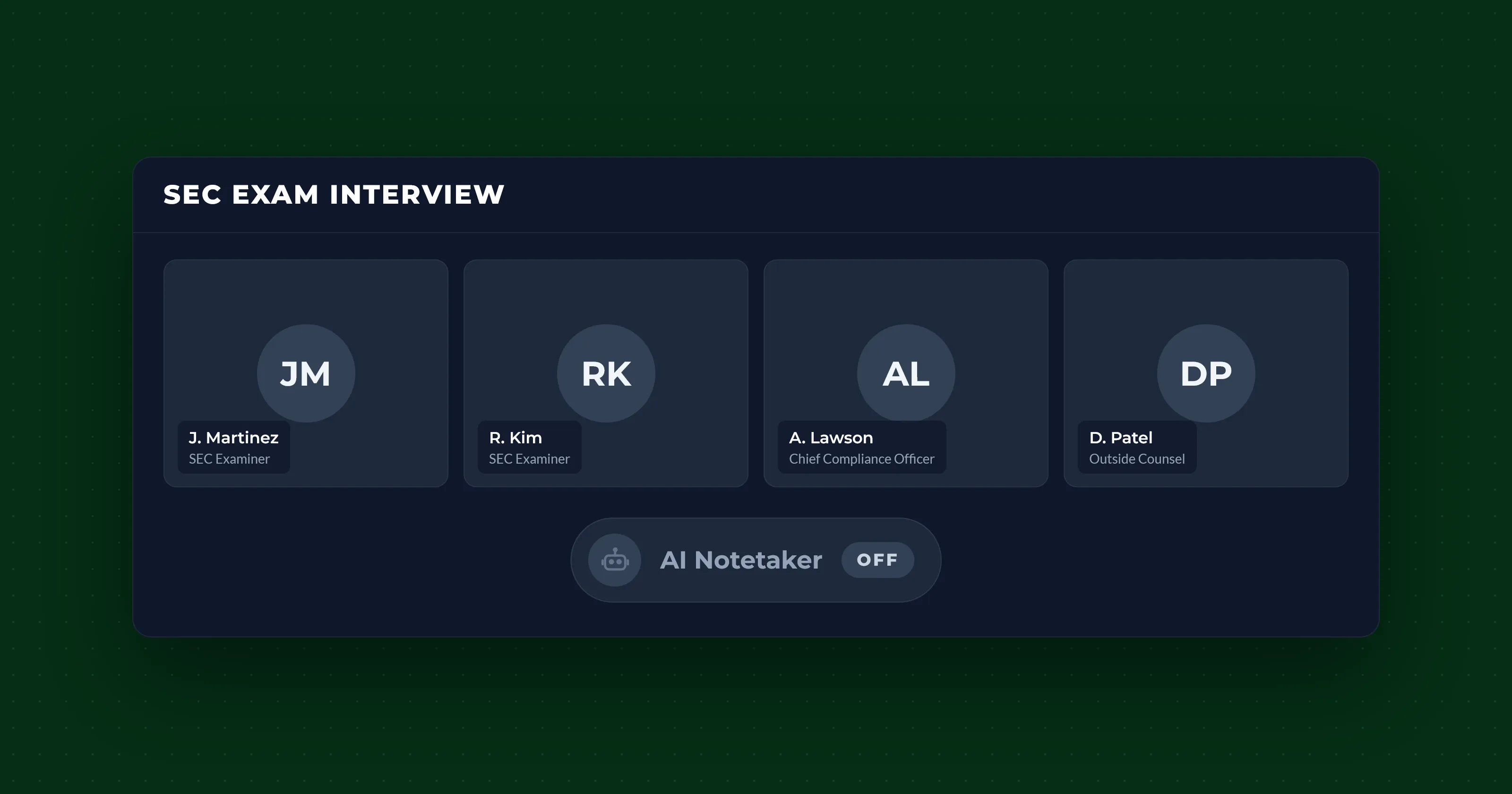
SEC exam staff do not want your AI notetaker on the call.
On October 1, the SEC’s Division of Examinations announced The SEC Exam Handbook: A Practical Guide on Process and Engagement, a walkthrough of how an exam runs. On page 8, in the section on interviews, it says:
“The staff does not record or transcribe meetings and instructs participants not to do so either. The staff does not consent to the use of recording, transcription, artificial intelligence notetaking tools, or other similar technologies.”
What the handbook says
Exam staff interview your chief compliance officer and other employees, and some of those interviews happen by videoconference. The handbook encourages people on those calls to turn on their cameras and share their screens.
The staff will not record or transcribe the meeting. They tell you not to either, and they do not consent to AI notetaking tools or similar technology.
The handbook says it is staff guidance, that it has no legal force, and that it creates no new obligations. It is not a new SEC rule. It is still an explicit statement of what exam staff will and will not consent to during these interviews. An automatically joining bot is therefore something to catch before the interview, not explain after it.
How firms break this by accident
Nobody plans to bring an AI notetaker to an SEC interview. The tool was already switched on.
- An AI notetaker linked to your calendar. You connected it months ago so you could stop taking notes in client meetings, and you have not thought about it since. The exam interview is on the same calendar, so it joins on its own and shows up in the participant list. You never invited it.
- A colleague on the call runs a transcription app on their own laptop or phone, the way they do for every meeting.
- A tool set to record every meeting by default records this one too.
Five minutes before the interview
- Turn off automatic notetakers and automatic recording for the exam meeting, not just for the person who is presenting.
- Tell everyone joining that nothing is recorded or transcribed, including on their own devices.
- Open your own calendar settings and look for any notetaker or meeting assistant you connected and forgot about that adds itself to meetings.
- Decide who takes notes the old way, and who your firm’s point of contact is.
- Ask whoever hosts the call to check the participant list when people join, and to remove anything that is not a person.
- If you are not sure whether something counts, ask your exam team before the call, not during it.
The SEC won’t give you a recording or transcript of the interview. Your firm therefore needs its own process for capturing what happened in the meeting. Assign a note-taker, write up the key points the same day, and use the follow-up emails the handbook encourages to correct anything the staff may have misunderstood.
What this does not say
The handbook is about the SEC’s interviews with you. It does not say anything about how you run your own client meetings or internal calls. It is not a ban on AI notetakers in general.
The question to decide on purpose
If your firm uses AI notetakers on client calls, those tools produce transcripts and summaries. An examiner can ask for business communications. An AI-generated summary of a client call about a recommendation is itself a business communication record your firm has created. Whether and how it must be retained is a question for your compliance team and counsel.
Decide it on purpose rather than leaving it to the tool’s default. Questions for your team:
- Which calls get an AI notetaker, and who decided that?
- Is the full transcript kept, the summary, both, or neither?
- Where does it live, and who can edit or delete it?
- If an examiner asks for every business communication with one client in one quarter, would these records be part of the answer?
If your firm decides to retain AI-generated call transcripts or summaries, those records need to fit into the same retention, access, and retrieval framework as the firm’s other business communications.
Where Comma fits
Comma brings business communications from more than 40 channels into one archive, including WhatsApp, Signal, iMessage, and call platforms such as Quo. That gives firms one place to search the communications they have decided to retain.
The takeaway
Before your next exam, switch off the notetakers for the interviews. Then, separately, decide what your firm does about the ones on client calls. The first takes ten minutes. The second is a policy question.
If you want to see how Comma keeps call transcripts and messages together, get in touch.